
19 April, 2026
0 Comments
1 category
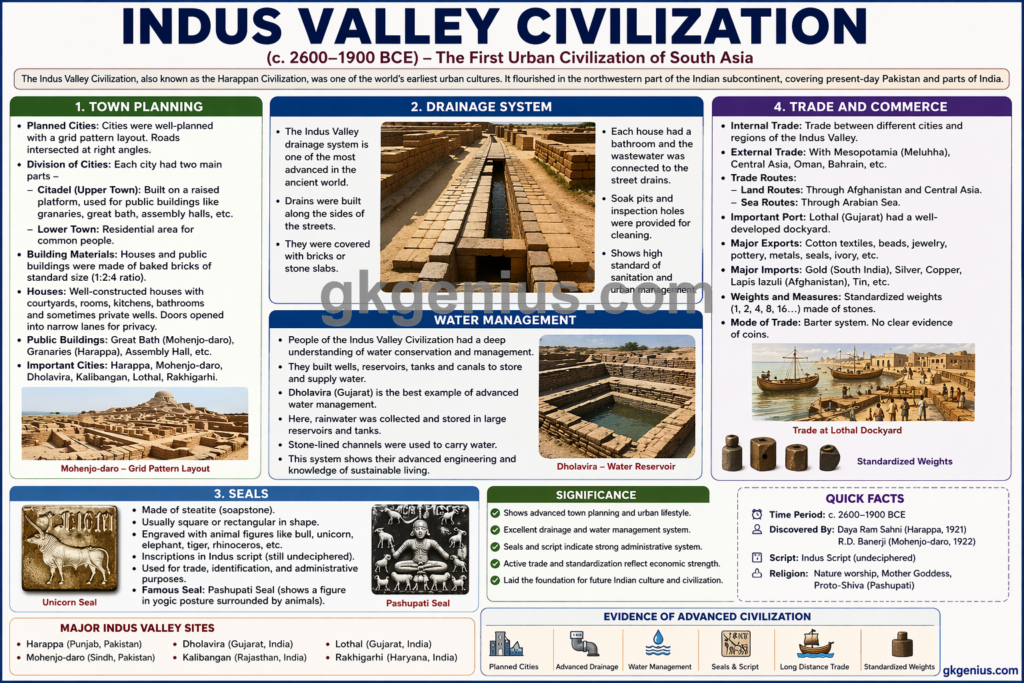
📍 1. Town Planning
The Indus Valley Civilization is known for its remarkably advanced urban planning, unmatched in many contemporary civilizations.
🔹 Key Features:
- Planned Cities (Grid System):
- Streets intersected at right angles, forming a grid pattern.
- Main roads were wide, straight, and well-laid.
- Division of Cities:
- Citadel (Upper Town):
- Elevated and fortified
- Contained public buildings like granaries, assembly halls, and the Great Bath
- Lower Town:
- Residential area where common people lived
- Citadel (Upper Town):
- Building Materials:
- Uniform use of baked bricks (standard size ratio 1:2:4)
- Strong and durable construction
- Houses:
- Multi-room houses with:
- Courtyards
- Bathrooms
- Private wells in some houses
- Doors often opened into lanes rather than main streets (for privacy)
- Multi-room houses with:
- Public Buildings:
- Great Bath at Mohenjo-daro
- Granaries at Harappa
- Important Cities:
- Harappa
- Mohenjo-daro
- Dholavira
- Kalibangan
🔹 Significance:
- Reflects centralized planning and governance
- Indicates a high degree of civic sense and organization
🚰 2. Drainage System
The drainage system of the Indus Valley Civilization was one of the most advanced in the ancient world.
🔹 Key Features:
- Well-constructed drainage network:
- Drains ran along main streets and were interconnected
- Made using bricks and mortar
- Covered Drains:
- Covered with stone slabs or bricks
- Prevented clogging and ensured hygiene
- Household Drainage:
- Each house had:
- A bathroom
- A drain connected to street drains
- Each house had:
- Soak Pits and Inspection Holes:
- Used for collecting waste and cleaning drains
- Allowed easy maintenance
- Separate Water Systems:
- Drinking water and waste water systems were often separate
🔹 Significance:
- Shows advanced knowledge of sanitation engineering
- Indicates strong focus on public health and cleanliness
🐂 3. Seals
Seals are one of the most important archaeological findings of this civilization.
🔹 Characteristics:
- Mostly made of steatite (soapstone)
- Typically square or rectangular in shape
- Polished and finely carved
🔹 Engravings:
- Animal figures:
- Bull, unicorn (most common), elephant, rhinoceros, tiger
- Script:
- Short inscriptions in Indus script (undeciphered)
🔹 Types of Seals:
- Animal seals
- Human or deity seals
- Composite figure seals
🔹 Purpose:
- Used as:
- Trade identifiers (like stamps)
- Marks of ownership or authority
- Possibly used in:
- Administrative and religious activities
🔹 Famous Seal:
- Pashupati Seal (proto-Shiva figure sitting in yogic posture)
🔹 Significance:
- Reflects artistic excellence
- Indicates existence of writing system and trade regulation
🚢 4. Trade and Commerce
Trade was a major strength of the Indus Valley economy.
🔹 Types of Trade:
- Internal Trade:
- Between cities like Harappa and Mohenjo-daro
- External Trade:
- With regions like:
- Mesopotamia (called “Meluhha” in Mesopotamian texts)
- With regions like:
🔹 Trade Routes:
- Land routes: Through Afghanistan and Central Asia
- Sea routes: Via Arabian Sea
🔹 Important Port:
- Lothal
- Had a well-developed dockyard
🔹 Major Trade Items:
- Exports:
- Cotton textiles (India is one of the earliest producers)
- Beads and jewelry
- Pottery and metal tools
- Imports:
- Gold (from South India)
- Silver, copper, lapis lazuli (from Afghanistan/Iran)
🔹 Weights and Measures:
- Standardized system (binary system: 1, 2, 4, 8, 16…)
- Made trade fair and organized
🔹 Mode of Trade:
- Mostly barter system
- No clear evidence of coinage
🔹 Significance:
- Shows economic prosperity
- Indicates international trade connections
- The Indus Valley Civilization was:
- Highly urbanized
- Technologically advanced
- Economically strong
- Its town planning and drainage system were far ahead of their time
- Seals and trade networks highlight its cultural and commercial sophistication
Category: Recent Posts
Related Posts
🔥 Revolt of 1857 (First War of Independence)
👉 First major uprising against British rule in India 📅…