
21 April, 2026
0 Comments
1 category
🌍 Background
- Europeans were searching for new sea routes to India for trade.
- Main aim: Spices, silk, cotton, and precious goods.
- Land routes were controlled by Ottoman Turks, making trade costly.
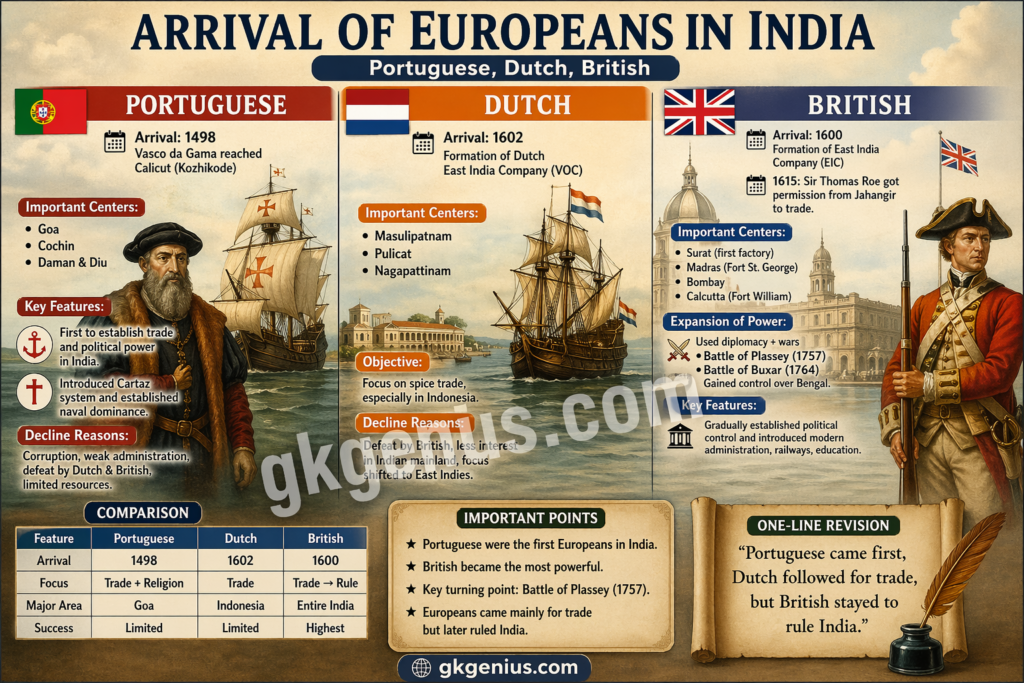
🇵🇹 Portuguese (First Europeans in India)
📅 Arrival
- 1498: Vasco da Gama reached Calicut (Kozhikode).
- Supported by King of Portugal.
🏢 Important Centers
- Goa (capital)
- Cochin
- Daman & Diu
👑 Key Features
- First to establish trade and political power in India.
- Introduced:
- Cartaz system (trade license)
- Naval dominance
📉 Decline Reasons
- Corruption & weak administration
- Defeat by Dutch & British
- Limited resources
🇳🇱 Dutch (VOC – Dutch East India Company)
📅 Arrival
- 1602: Formation of Dutch East India Company.
🏢 Important Centers
- Masulipatnam
- Pulicat
- Nagapattinam
🎯 Objective
- Focus on spice trade, especially in Indonesia.
📉 Decline Reasons
- Defeat by British
- Less interest in Indian mainland
- Focus shifted to East Indies
🇬🇧 British (East India Company)
📅 Arrival
- 1600: Formation of East India Company.
- 1615: Sir Thomas Roe got permission from Jahangir to trade.
🏢 Important Centers
- Surat (first factory)
- Madras (Fort St. George)
- Bombay
- Calcutta (Fort William)
⚔️ Expansion of Power
- Used diplomacy + wars:
- Battle of Plassey → Defeated Siraj-ud-Daulah
- Battle of Buxar → Gained control over Bengal
👑 Key Features
- Gradually established political control
- Introduced modern administration, railways, education
🔍 Comparison Table
| Feature | Portuguese | Dutch | British |
|---|---|---|---|
| Arrival | 1498 | 1602 | 1600 |
| Focus | Trade + Religion | Trade | Trade → Rule |
| Major Area | Goa | Indonesia | Entire India |
| Success | Limited | Limited | Highest |
📝 Important Points for Exams
- Portuguese were the first Europeans in India.
- British became the most powerful.
- Key turning point: Battle of Plassey (1757).
- Europeans came mainly for trade but later ruled India.
🎯 One-Line Revision
👉 “Portuguese came first, Dutch followed for trade, but British stayed to rule India.”
Category: Recent Posts